
Minimum Date vs Release
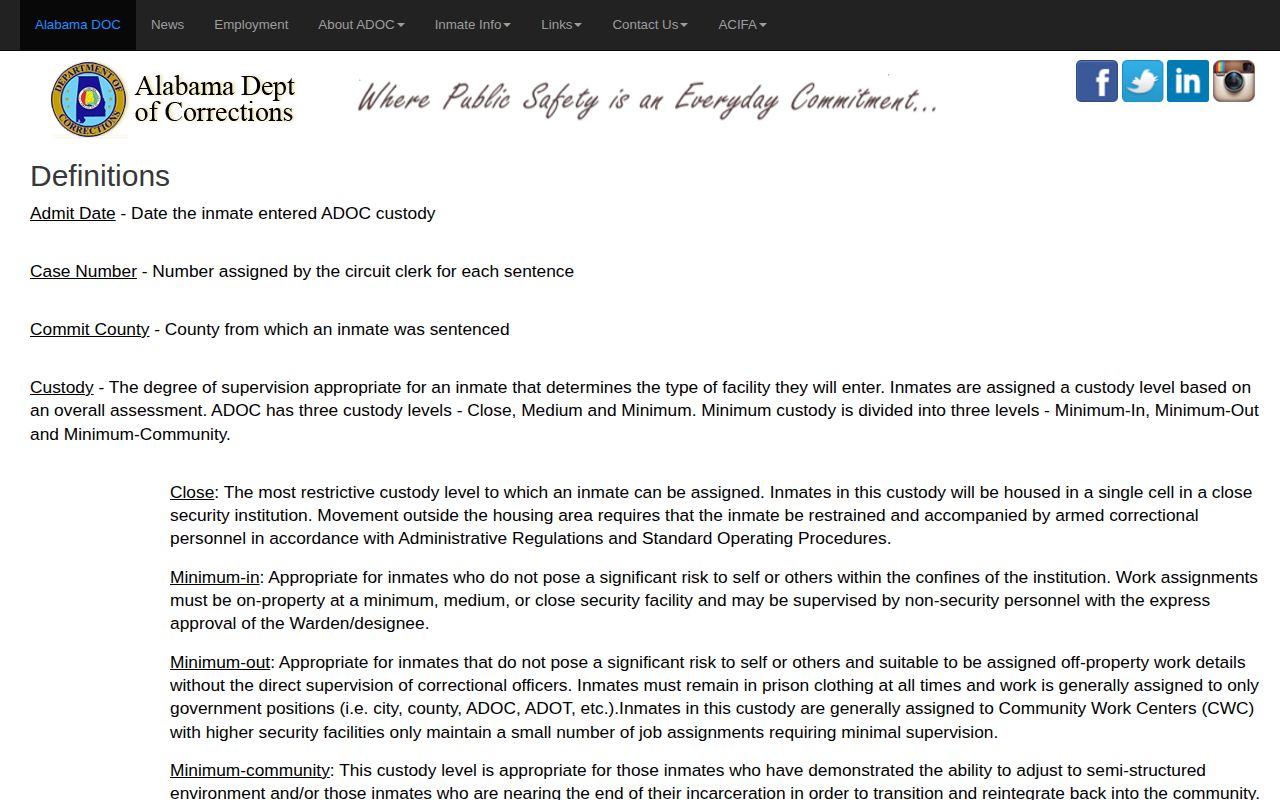
Alabama's public ADOC terminology is "Minimum Release Date," not a generic county projected-release label. ADOC defines it as the earliest scheduled date an inmate can be released to probation or end of sentence. The same definitions page identifies "Parole Consideration Date" as a tentative date set by the Parole Board and "Parole Status" as whether an inmate is on parole, delinquent, or revoked.
Scheduled is not actual: A minimum date is a current-custody planning field. The actual release record is confirmed later through ADOC, ABPP, Alabama VNS/VINE, the court, or a records request, depending on the custody type.
Find a Projected Date
Start with the custody system. Jackson County's jail roster can show an actual Release Time after release, but it does not publish a local sentence calculator. ADOC can show a minimum date while a sentenced state prisoner is currently incarcerated.
- If the person is in Jackson County jail before trial, check the current roster and court docket. There may be no set release date.
- If a recent local release is possible, check the sheriff's 48 Hour Release roster for the actual Release Time.
- If the person was sentenced to state prison, search ADOC by AIS number when known, or by first and last name.
- Read ADOC date fields as current-custody planning fields. ADOC says its public search contains currently incarcerated inmates and historical data is not available online.
- For parole timing, check ABPP scheduled hearings, cancellations, results, and the Public Information Unit.
- For the court action that caused local release, use the Jackson County Circuit Clerk / Alacourt path.
A person in the Jackson County Sheriff's Office Detention Center before trial often has no true projected release date because the next custody event depends on bond, a court order, transfer, dismissal, sentence, or another case event. In that setting, the useful public records are the current roster, the court docket, and jail contact, not a release-date calculator. After release, the 48 Hour Release roster can show the actual Release Time for a short period.
For a sentenced state prisoner, the search changes. ADOC's AIS number is the cleanest identifier because ADOC says it takes precedence over first and last name fields. If the AIS number is not known, name searches can still work, but partial and common names need careful matching. The Minimum Release Date should be copied with the date of the search because disciplinary action, new cases, sentence updates, or parole decisions can change the record later.
Alabama Good-Time Rules
Alabama Code Section 14-9-41 governs correctional incentive time. The statute creates classification levels tied to conduct, work habits, supervision, and rule compliance. Class IV receives no correctional incentive time and is described as flat time or day-for-day. Higher classification does not retroactively create credit for time already served in a lower class.
The same statute excludes correctional incentive time for several categories, including Class A felony convictions, crimes causing death by deadly weapon, life sentences, death sentences, sentences of more than 15 years, and certain child sex offenses. It also permits forfeiture of accrued incentive time for prison offenses or rule violations. That is why two Alabama prisoners with similar sentence lengths can have different minimum release dates.
Alabama voluntary truth-in-sentencing rules under Section 12-25-36 use a minimum term and an extended term with post-release supervision. The research does not support a simple statewide "85 percent" rule for every Alabama prisoner, so release-date copy should use the actual Alabama fields and statutes instead of a generic percentage calculator.
These rules are also why a Jackson County sentence can produce different public answers at different stages. The jail may hold the person before transfer or for a short local term. The court may state the sentence and any jail credit. ADOC applies state-prison calculations for eligible prisoners in its custody. ABPP then handles parole consideration and supervision paths. No single local roster field combines all of those steps into a complete statewide release computation.
Why Dates Move
A projected date is not fixed until release occurs. ADOC says the Minimum Release Date can change if disciplinary action removes good time or if the circuit clerk sends new cases or changes the current sentence.
| Factor | Effect on the date |
|---|---|
| Disciplinary action | Can remove accrued incentive time or end eligibility for serious violations. |
| New case or sentence change | ADOC notes that circuit clerk updates can alter the current sentence and minimum date. |
| Parole processing | ABPP eligibility, hearings, grants, denials, or continuances can affect release planning. |
| Mandatory supervision | Eligible state-prison releases may include supervision under Alabama law, separate from county jail release. |
| County court orders | Bond, revocation, dismissal, sentence completion, or other orders may explain local release from the Detention Center. |
Detainers and transfers can also change what a user sees. If another county, federal agency, or immigration authority has the next custody claim, release from Jackson County jail may mean movement to another system rather than return to the community. In that case, the Jackson County release record confirms departure from the local Detention Center, while the receiving agency controls the next public lookup.
Actual release check: Compare the planned date against the later record. For Jackson County jail, use Release Time and court records. For ADOC, use ABPP, VNS/VINE, and ADOC records when the public search no longer answers the question.
Confirm Actual Release
For a Jackson County jail release, the sheriff's 48 Hour Release roster is the public web source for a very recent actual Release Time. Once that rolling window passes, use the Detention Center, Sheriff's Office records, or the Jackson County Circuit Clerk / Alacourt record. For a state-prison release, use ABPP, Alabama VNS/VINE, ADOC public records, and the court record as appropriate. The VINELink Inmate Search page explains how to register for custody-change notices when a matching record is available.
When asking an office for a release-date record, include the person's full name, date of birth if known, booking number or AIS number if known, and the approximate booking, sentence, or release date. For county records, the Sheriff's Office and Detention Center are the local starting points. For ADOC records, the research points to Form 023-A and the Public Records Coordinator process, including the state policy on processing fees and response timing. For court records, the Circuit Clerk and Alacourt explain bond, disposition, sentence, revocation, or dismissal events that a roster does not fully describe.
County Jail Date Limits
The Jackson County roster does not publish a county good-time calculator, daily release schedule, or local weekend-release rule. A short county sentence release date should be verified with the Detention Center and sentencing court. After release, the roster can show the actual Release Time during the 48-hour web window, but it usually does not explain the computation or legal reason for release.
The individual roster profile note adds a practical local warning: charges and bail amounts may change after court appearances and may not be current online. It directs people who need correct bail amount, charges, and case numbers to Detention Center staff at 256-574-1884 extensions 824 or 823. That detail belongs in projected-release research because bond and court activity can be the reason a pretrial detainee leaves before any sentence-based date exists.
Note: A projected date, a parole consideration date, and an actual Release Time should never be treated as the same field.
Records That Outlast Dates
A release-date lookup should end with a record that can still be found after the date passes. For Jackson County jail custody, that means the booking or release record from the Sheriff's Office or Detention Center and the court docket from the Thirty-Eighth Judicial Circuit. The roster is useful during the short public window, but the court record is the more durable source for the order or disposition behind release.
For ADOC custody, the public search can help while the person is currently incarcerated. After the person leaves state custody, ADOC's online search may no longer answer the question because the public database is not a historical release archive. At that point, use ABPP for parole or supervision, Alabama VNS/VINE for registered notifications, ADOC public records for maintained corrections records, and court records for sentence or case changes.
Federal and immigration releases should stay outside the county and ADOC date logic. BOP's locator can show federal release dates from 1982 forward, while ICE's locator is focused on current ICE custody or qualifying CBP custody. A Jackson County roster release can be one step before those systems, but it is not their release-date record.
When the date is disputed, compare the field names. Release Time is a county jail roster field for an actual local release. Minimum Release Date is an ADOC planning field for a currently incarcerated state prisoner. Parole Consideration Date is an ABPP-related timing field, not a promise of release. A court order may create, change, or explain any of those records. Keeping the labels separate prevents a planned state date from being mistaken for a completed Jackson County jail release.
For records requests, use the office that holds the record. County booking and release records start with the Sheriff's Office or Detention Center. State-prison records start with ADOC's Public Records Coordinator. Parole and granted-but-not-yet-released questions start with ABPP. Court orders, bond, disposition, and sentence changes start with the Jackson County Circuit Clerk or Alacourt records.
ADOC's public-record rule also affects timing expectations. The research notes a processing fee for ADOC public-records requests unless an exception applies, and work does not begin until the fee is received. It distinguishes standard requests from time-intensive requests and gives different response and disclosure periods after acknowledgment and payment. That state policy is useful for ADOC release records, but it does not control a Jackson County jail request.
For local jail records, the sheriff's public web roster is faster but shorter. It can show a recent Release Time, yet the maintained booking or release record may be needed after the 48-hour public window. If a court order caused release, the docket may be the best source even when the jail can confirm the person left the facility.